Call Python, Ruby, JavaScript (Node.js, Bun, Deno or QuickJS), PHP, Java and Go from Elixir through supervised, pooled worker processes. Portals is a spiritual successor to ErlPort.
{:ok, 2} = Portals.Pool.call(MyApp.Python, "text_tools", "word_count", ["hello world"])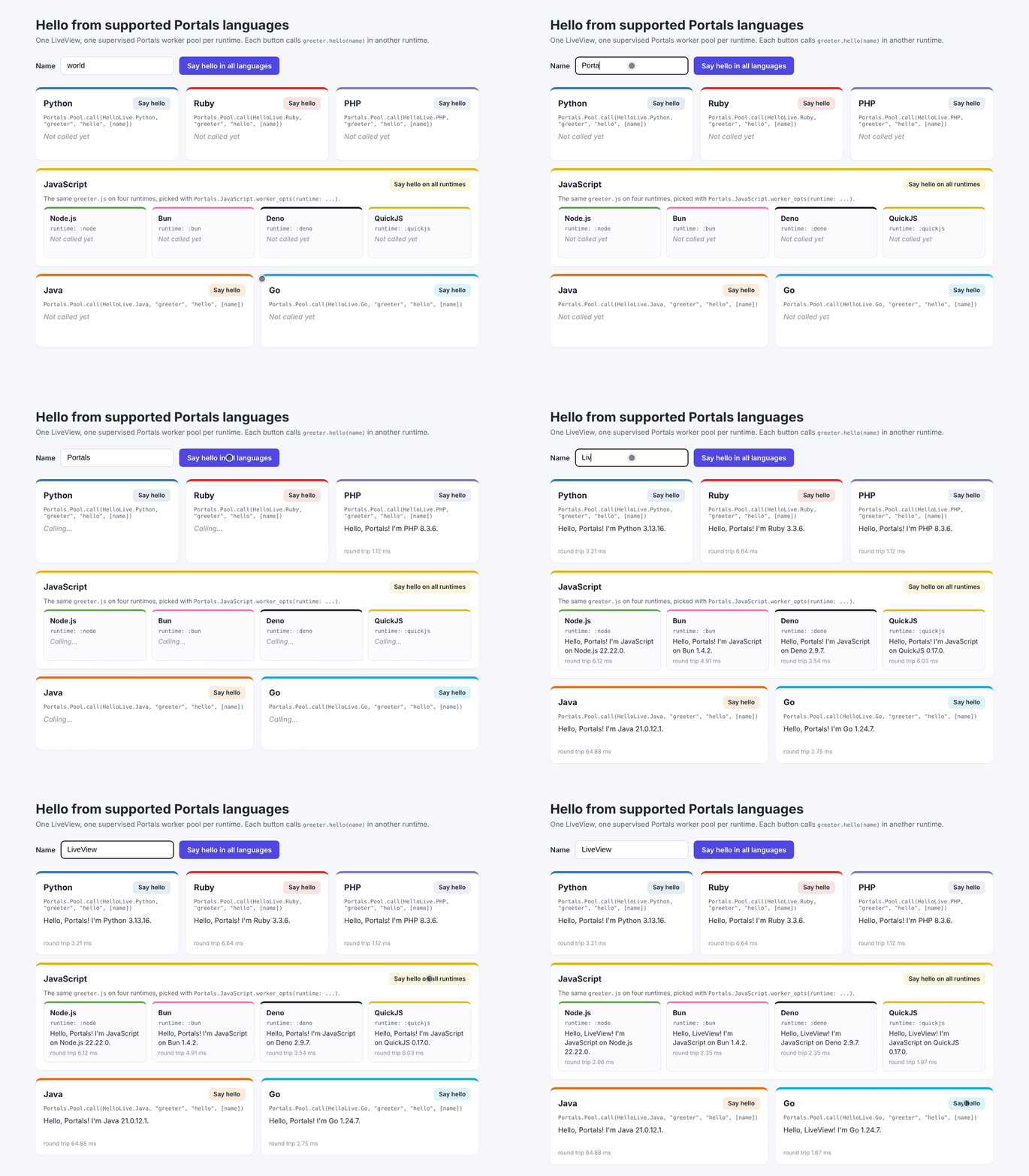
examples/hello_live:
one LiveView page calling greeter.hello(name) in a supervised worker pool
per language, and per JavaScript runtime. The replies arrive independently,
as each runtime answers.
Each worker is an ordinary program in its own language, running in its own OS process under OTP supervision. A crash, hang or bad output in a worker never takes down the BEAM. On top of plain calls you get:
- Pools with overflow workers, least-busy scheduling and bounded checkout.
- Structured errors:
{:error, %Portals.Error{}}with the remote exception type, message and stack trace. - Callbacks from the worker into Elixir, and messages from the worker to any PID.
- Bidirectional streaming with byte-credit backpressure in both directions.
- Deadlines and cooperative cancellation.
- Exact protocol versioning: every SDK speaks the same documented wire protocol and passes the same conformance suite.
Install only the languages you use
Core portals has no worker SDKs. Each language is its own Hex package
that bundles its SDK. Nothing is installed from PyPI, RubyGems, npm,
Packagist, Maven or the Go module proxy.
| Language | Package | Guide |
|---|---|---|
| Python | portals_python | Python guide |
| Ruby | portals_ruby | Ruby guide |
| JavaScript (Node.js, Bun, Deno, QuickJS) | portals_javascript | JavaScript guide |
| PHP | portals_php | PHP guide |
| Java | portals_java | Java guide |
| Go | portals_go | Go guide |
def deps do
  [
    {:portals_python, "~> 0.1.0"}
  ]
end
Every package is released in lockstep with portals at the same version,
so a worker SDK always speaks exactly the protocol the BEAM expects.
Quick start (Python)
# priv/python/text_tools.py
def word_count(text):
    return len(text.split())
# priv/python/worker.py
from portals import Worker
Worker().run()# lib/my_app/application.ex
children = [
{Portals.Pool,
Portals.Python.worker_opts(
script: Application.app_dir(:my_app, "priv/python/worker.py"),
name: MyApp.Python,
size: 4
)}
]iex> Portals.Pool.call(MyApp.Python, "text_tools", "word_count", ["hello world"])
{:ok, 2}To see all six languages in one app, run the
hello_live example
shown at the top of this page.
Start with Getting started, then read the guide for your language. Each one walks through a complete worker covering calls, errors, callbacks, messages, streaming, deployment, gotchas and best practices.
Status
Pre-1.0. The protocol, Elixir API and six SDKs are implemented and tested. Linux is the supported platform. See docs/prd.md for the roadmap.
Repository layout
lib/, test/            core `portals` (the Elixir side)
protocol/              the wire protocol spec, golden vectors, malformed fixtures
guides/                hexdocs guides, one page per language
packages/portals_<language>/
  lib/                 the Portals.<Language> launch helper
  priv/<language>/     the bundled worker SDK, with its own unit tests
  test/                the shared conformance suites run against that SDK
examples/hello_live/   a Phoenix LiveView app calling every language and JS runtime
scripts/               test_all.sh, version.exs, release.sh, hex_dry_run.sh, publish_hex.sh
See CONTRIBUTING.md for development and releases.
License
MIT